
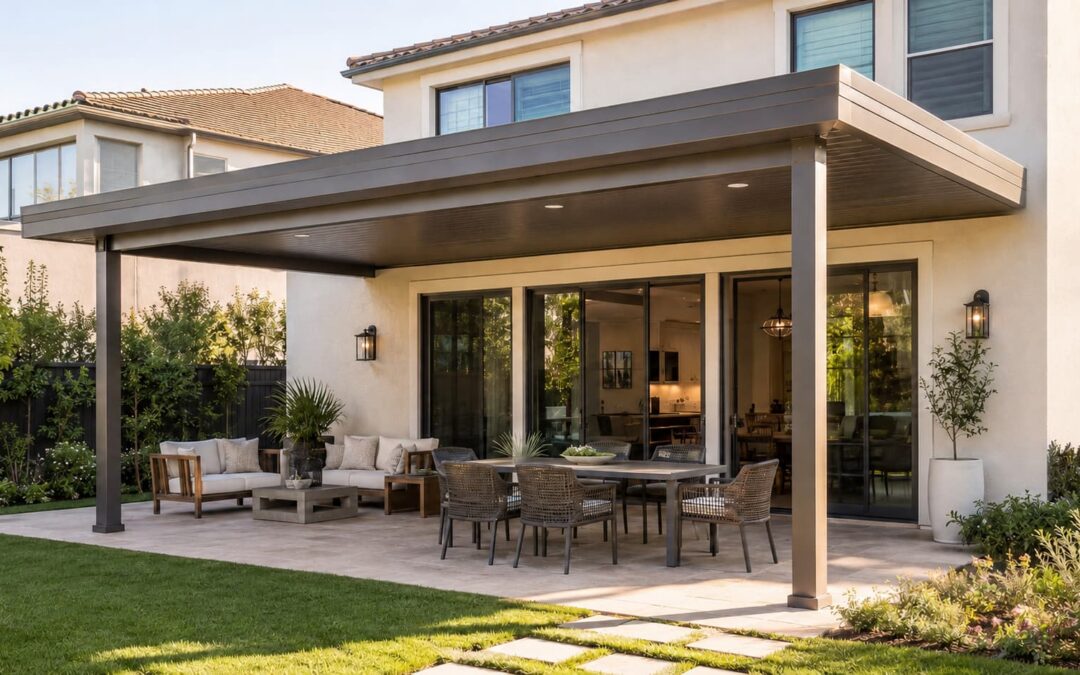
A patio cover should not look like somebody simply bolted a roof to the back of the house.
That may sound obvious, but it is one of the biggest differences between an average patio cover and one that actually improves the home. Two covers can use similar materials, similar colors, and even similar square footage, yet one looks like it belongs and the other looks like an afterthought.
In Orange County, that matters. Homes here vary from coastal cottages and Spanish-style homes to newer tract homes, hillside properties, and modern remodels. A patio cover that works beautifully in Huntington Beach may need a different approach than one in Mission Viejo, Yorba Linda, Irvine, or Laguna Niguel.
The product matters, of course. But the design matters just as much.
A Built-In Patio Cover Starts With the House
Before choosing lattice, solid, insulated, or louvered, the first question should be simple: what does the house want?
An experienced patio cover designer looks at the home before looking at the catalog. The roof lines, fascia height, windows, doors, stucco, trim, color, backyard layout, and existing concrete all tell part of the story.
If those details are ignored, the patio cover may still provide shade, but it can look disconnected from the home. It may sit too high, too low, too far to one side, or in a way that makes the backyard feel chopped up.
That is why the best patio cover design is not just about covering the largest possible area. It is about making the new structure feel as if it were planned with the home from the beginning.
Roof Lines and Fascia Height Make a Big Difference
One of the first things to study is where the patio cover can attach.
Some homes have a clean fascia board that allows for a straightforward attachment. Others have low roof lines, second-story windows, roof returns, uneven elevations, or architectural details that limit where a cover can go.
If the attachment point is too low, the patio can feel compressed. If the cover is forced too high or attached awkwardly, it can look like it is floating away from the house. The goal is to find the cleanest transition possible from the existing home to the new shade structure.
This is one reason homeowners should be cautious about comparing patio cover quotes based only on size and price. Two contractors may quote the same approximate dimensions, but one may be thinking carefully about the attachment, pitch, drainage, height, and finished look. The other may simply be measuring a rectangle.
Post Placement Can Make or Break the Backyard
Posts are structural, but they are also visual. Where they land affects how the patio feels, how furniture fits, how people move through the space, and how open the backyard feels.
A poorly placed post can interrupt a sliding door, crowd an outdoor dining table, block a view, or make a small patio feel even smaller. A better design thinks through how the homeowner will actually use the space.
Before finalizing a patio cover layout, it helps to ask:
- Where will the outdoor table or seating go?
- Is there a barbecue, pool, spa, or walkway to account for?
- Will the posts interfere with doors or windows?
- Does the backyard need to feel open from inside the house?
- Would a different beam or span create a cleaner layout?
Sometimes the better patio cover is not the biggest one. It is the one with the right proportions and the right post layout.
Color Matching Is More Than Picking White or Adobe
Color is another detail that separates a built-in look from an add-on look.
Many aluminum patio covers come in attractive standard colors, but the best choice depends on the home. A color that looks great on one house can feel too stark or too heavy on another. Fascia color, stucco tone, window trim, roof color, hardscape, and even nearby walls all matter.
In some cases, matching the fascia creates the cleanest look. In others, a soft contrast works better. For certain homes, a darker beam or accent color can help the patio cover feel more architectural.
The point is not to choose the most popular color. The point is to choose the color that makes the patio cover feel intentional.
The Right Product Should Match the Way the Patio Will Be Used
A patio cover that looks built-in also needs to function correctly. The best-looking design will disappoint if it does not solve the homeowner’s real problem.
For some homes, an open lattice patio cover is the right answer because the homeowner wants filtered light, airflow, and partial shade without making the house feel darker inside.
For others, a Newport flat panel patio cover may be a better fit because the goal is stronger shade, rain protection, and a more finished ceiling appearance.
When heat reduction is a major concern, especially on patios with heavy afternoon sun, an insulated Maxx Panel patio cover may be worth considering. For homeowners who want adjustable light-and-shade control, an Equinox louvered roof system may be the better design direction.
There is no single product that is perfect for every backyard. The right choice depends on sun exposure, architecture, budget, lifestyle, and how the patio will be used throughout the year.
Scale and Proportion Matter More Than People Think
A patio cover can be technically correct and still look wrong.
Sometimes the beams look too small for the house. Sometimes the cover is too shallow to be useful. Sometimes it projects too far into the yard and overwhelms the space.
Sometimes the cover is centered on the slab but not on the home, which can make the whole backyard feel slightly off.
Good design means stepping back and looking at the entire composition. The patio cover should feel balanced with the house, not just attached to it.
This is especially important in Orange County neighborhoods where homes often sit close together, yards may be compact, and patios are visible from the kitchen, family room, or primary bedroom. The cover becomes part of the daily view. It should be something the homeowner enjoys looking at, not just something that blocks the sun.
Electrical, Lighting, and Accessories Should Be Planned Early
Ceiling fans, recessed lights, outlets, heaters, and speakers can make a patio more useful, but they should be discussed early in the design process.
If accessories are treated as an afterthought, the finished project can look cluttered. Wiring may be harder to hide, fixtures may not align properly, and the patio may not function as the homeowner expected.
On a solid or insulated patio cover, lighting and fan placement should be oriented toward the seating area below. On a lattice cover, the homeowner may need a different approach. In a louvered system, controls, drainage, and motorized components all need to be considered in the design.
The cleanest projects happen when function is built into the plan from the beginning.
A Built-In Look Comes From Better Questions
Many homeowners start by asking, “How much is a patio cover?” That is a fair question, but it should not be the only question.
Better questions include:
- What style of patio cover fits this house?
- Where should the posts land so the space stays usable?
- Will this design make the inside of the house too dark?
- How will the cover drain during rain?
- Will the color and beam size look right with the home?
- Are there HOA, permit, or setback issues to consider?
- Will this still look good five or ten years from now?
Those questions lead to better patio covers because they focus on the whole project, not just the product.
The Best Patio Cover Should Feel Like It Belongs
A well-designed patio cover does more than create shade. It changes how the backyard feels. It gives the home a more finished outdoor living area. It makes the patio more comfortable, more useful, and often more attractive from both inside and outside the house.
That does not happen by accident.
It comes from looking carefully at the home, understanding how the homeowner wants to use the space, choosing the right product, and making design decisions that support the architecture rather than fight it.
If you are planning a patio cover in Orange County, take the time to think beyond size and price. The right design should not look like an add-on. It should look like it belongs.
Factory Direct Patio Covers helps Orange County homeowners design genuine Alumawood, Maxxwood, and Equinox patio cover systems that fit the home, the backyard, and the way the space will actually be used. To start planning your project, visit our product page, browse our gallery, or contact us for help with your patio cover design.